Home›Materials›Signals and Systems›Signals and Systems – Complete Study Notes (Units 1–6)
About this material
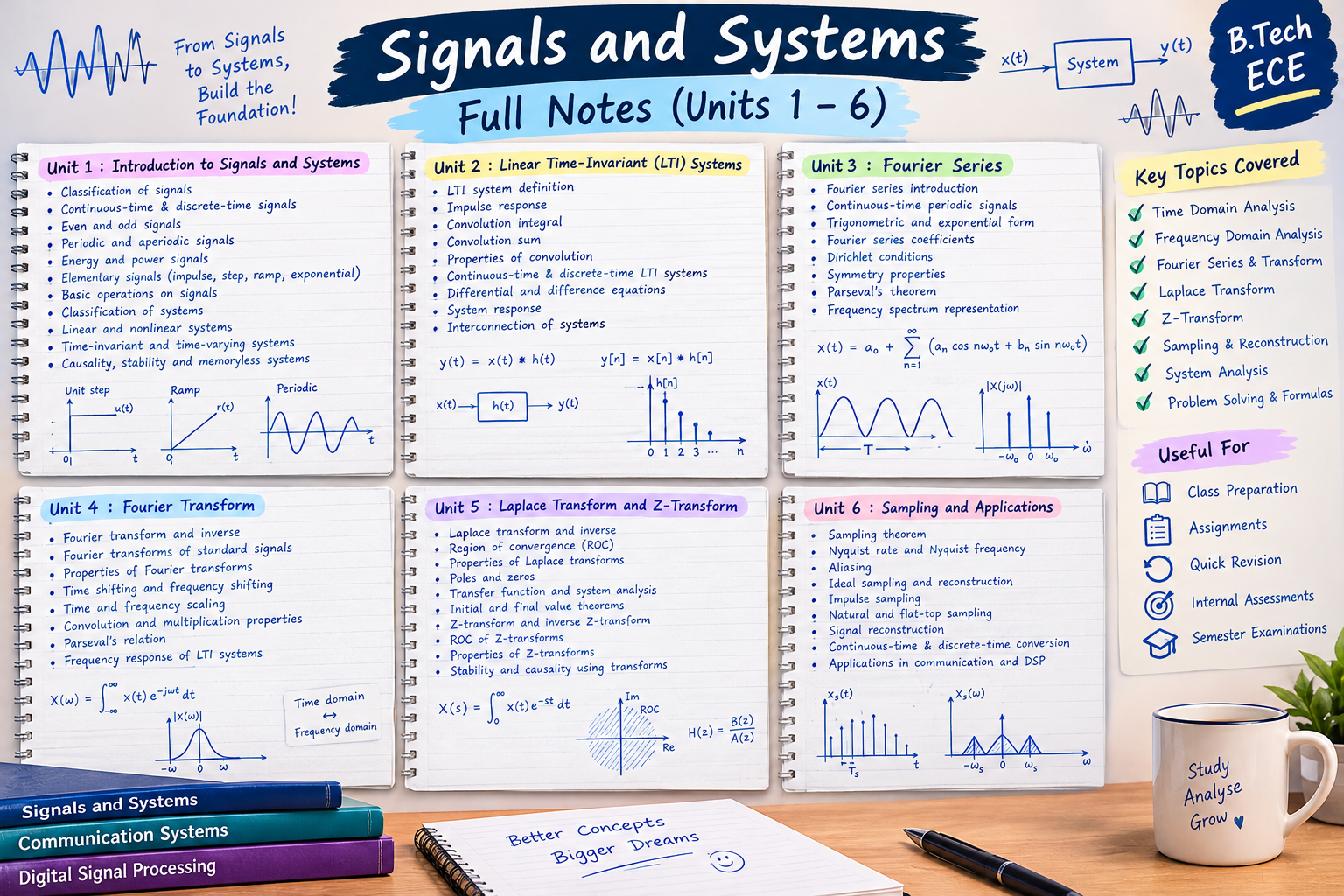
Comprehensive study notes covering the fundamental concepts of Signals and Systems, including signal classification, system properties, time and frequency domain analysis, Fourier transforms, Laplace transforms, Z-transforms and sampling.
Unit 1 – Introduction to Signals and Systems
Definition and classification of signals
Continuous-time and discrete-time signals
Even and odd signals
Periodic and aperiodic signals
Energy and power signals
Elementary signals: impulse, step, ramp and exponential
Basic operations on signals
Classification of systems
Linear and nonlinear systems
Time-invariant and time-varying systems
Causality, stability and memoryless systems
Unit 2 – Linear Time-Invariant (LTI) Systems
Introduction to LTI systems
Impulse response
Convolution integral
Convolution sum
Properties of convolution
Continuous-time and discrete-time LTI systems
Differential and difference equations
System response and interconnection of systems
Unit 3 – Fourier Series
Introduction to Fourier series
Continuous-time periodic signals
Trigonometric and exponential Fourier series
Fourier series coefficients
Dirichlet conditions
Symmetry properties of Fourier series
Parseval's theorem
Frequency spectrum representation
Unit 4 – Fourier Transform
Fourier transform and inverse Fourier transform
Fourier transforms of standard signals
Properties of Fourier transforms
Time shifting and frequency shifting
Time and frequency scaling
Convolution and multiplication properties
Parseval's relation
Frequency response of LTI systems
Unit 5 – Laplace Transform and Z-Transform
Laplace transform and inverse Laplace transform
Region of convergence (ROC)
Properties of Laplace transforms
Poles and zeros
Transfer function and system analysis
Initial and final value theorems
Z-transform and inverse Z-transform
ROC of Z-transforms
Properties of Z-transforms
Stability and causality using transforms
Unit 6 – Sampling and Applications
Sampling theorem
Nyquist rate and Nyquist frequency
Aliasing
Ideal sampling and reconstruction
Impulse sampling
Natural and flat-top sampling
Signal reconstruction
Continuous-time and discrete-time signal conversion
Applications of Signals and Systems in communication and signal processing
Learning Outcomes
Understand and classify different types of signals and systems.
Analyze LTI systems using convolution.
Solve problems using Fourier, Laplace and Z-transforms.
Understand sampling, aliasing and signal reconstruction.
Prepare for assignments, internal assessments and semester examinations.
Note: Unit topics may vary according to the university syllabus. These notes provide a general six-unit outline and should be matched with the prescribed syllabus.
Preview
10 files — tap a file to preview it
Files
Preview of Signals and Systems – Complete Study Notes (Units 1–6)
Downloads
- Download
R20 SS 1-2_3_5 UNITS_merged.pdf
PDF · 15.3 MB
- Download
SS unit 1.pdf
PDF · 6.2 MB
- Download
Unit-1.pdf
PDF · 18.1 MB
- Download
ss unit 2 total.pdf
PDF · 5.2 MB
- Download
unit 3..part 1.1.pdf
PDF · 1.7 MB
- Download
unit 3..part 1.pdf
PDF · 2.6 MB
- Download
Unit - 4 .pdf
PDF · 11.6 MB
- Download
unit 4.pdf
PDF · 11.6 MB
- Download
unit 5.pdf
PDF · 8.1 MB
- Download
unit 6.pdf
PDF · 1.3 MB