Home›Materials›Electromagnetic Waves and Guided Media (EWGM)›Electromagnetic Waves and Guided Media (EWGM) – Complete Study Notes (Units 1–6)
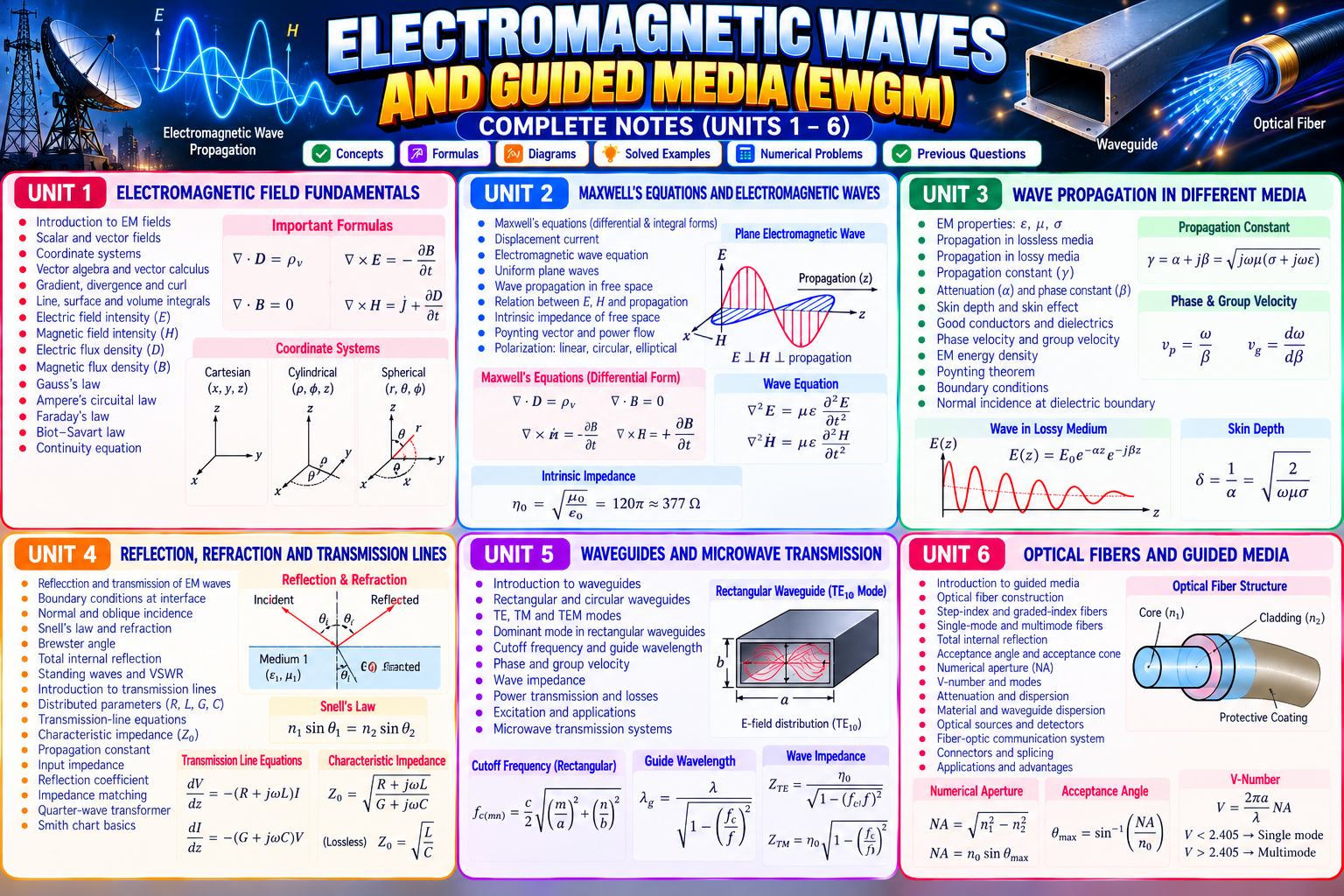
Electromagnetic Waves and Guided Media (EWGM) – Complete Study Notes (Units 1–6)Free
About this material
Electromagnetic Waves and Guided Media (EWGM) – Complete Study Material (Units 1–6)
Comprehensive study material covering electromagnetic field fundamentals, Maxwell's equations, electromagnetic wave propagation, reflection and refraction, transmission lines, waveguides and optical fibers. Includes important formulas, field equations, diagrams, derivations and numerical problem topics.
Unit 1 – Electromagnetic Field Fundamentals
Introduction to electromagnetic fields
Scalar and vector fields
Coordinate systems: Cartesian, cylindrical and spherical
Vector algebra and vector calculus
Gradient, divergence and curl
Line, surface and volume integrals
Electric field intensity and electric flux density
Gauss's law and its applications
Electric potential and potential difference
Magnetic field intensity and magnetic flux density
Ampere's circuital law
Faraday's law of electromagnetic induction
Biot–Savart law
Continuity equation
Unit 2 – Maxwell's Equations and Electromagnetic Waves
Maxwell's equations in differential and integral forms
Gauss's law for electric fields
Gauss's law for magnetic fields
Faraday's law
Ampere–Maxwell law
Displacement current
Electromagnetic wave equation
Wave propagation in free space
Uniform plane waves
Electric and magnetic field relationships
Wave velocity, wavelength and frequency
Intrinsic impedance of free space
Poynting vector and power flow
Polarization of electromagnetic waves
Linear, circular and elliptical polarization
Unit 3 – Wave Propagation in Different Media
Electromagnetic properties of materials
Permittivity, permeability and conductivity
Propagation in lossless media
Propagation in lossy media
Propagation constant
Attenuation and phase constants
Skin depth and skin effect
Wave propagation in good conductors
Wave propagation in dielectrics
Phase velocity and group velocity
Electromagnetic energy density
Power transmission and Poynting theorem
Boundary conditions for electromagnetic fields
Normal incidence at dielectric boundaries
Unit 4 – Reflection, Refraction and Transmission Lines
Reflection and transmission of electromagnetic waves
Boundary conditions at interfaces
Normal and oblique incidence
Snell's law and refraction
Brewster angle
Total internal reflection
Standing waves and standing-wave ratio
Introduction to transmission lines
Distributed circuit parameters: R, L, G and C
Transmission-line equations
Characteristic impedance
Propagation constant
Input impedance of transmission lines
Reflection coefficient
Voltage Standing Wave Ratio (VSWR)
Impedance matching fundamentals
Quarter-wave transformer
Smith chart fundamentals
Unit 5 – Waveguides and Microwave Transmission
Introduction to waveguides
Rectangular waveguides
Circular waveguides
Transverse Electric (TE) modes
Transverse Magnetic (TM) modes
TEM mode and its characteristics
Dominant mode in rectangular waveguides
Cutoff frequency and cutoff wavelength
Guide wavelength
Phase velocity and group velocity in waveguides
Wave impedance
Power transmission in waveguides
Waveguide losses
Waveguide excitation and applications
Introduction to microwave transmission systems
Unit 6 – Optical Fibers and Guided Media
Introduction to guided electromagnetic waves
Types of guided media
Optical fiber construction and working principle
Core, cladding and protective coating
Step-index and graded-index fibers
Single-mode and multimode fibers
Total internal reflection in optical fibers
Acceptance angle and acceptance cone
Numerical aperture
V-number and modes of propagation
Attenuation and dispersion in optical fibers
Material and waveguide dispersion
Fiber-optic communication system
Optical sources and detectors: LED, laser diode and photodetector
Fiber-optic connectors and splicing
Applications, advantages and limitations of optical fibers
Learning Outcomes
Understand electromagnetic field concepts and Maxwell's equations.
Analyze electromagnetic wave propagation in different media.
Calculate reflection, transmission and wave parameters.
Analyze transmission-line characteristics and impedance matching.
Understand TE, TM and TEM modes in waveguides.
Explain optical fiber operation, numerical aperture and dispersion.
Apply electromagnetic theory to communication and guided-wave systems.
This material is useful for class preparation, assignments, derivations, numerical practice, revision and semester examination preparation.
Note: This is a general six-unit reference outline. The exact unit divisions and topics may vary according to your university syllabus.
Preview
8 files — tap a file to preview it