Home›Materials›Robotics›Robotics – Complete Reference Notes
About this material
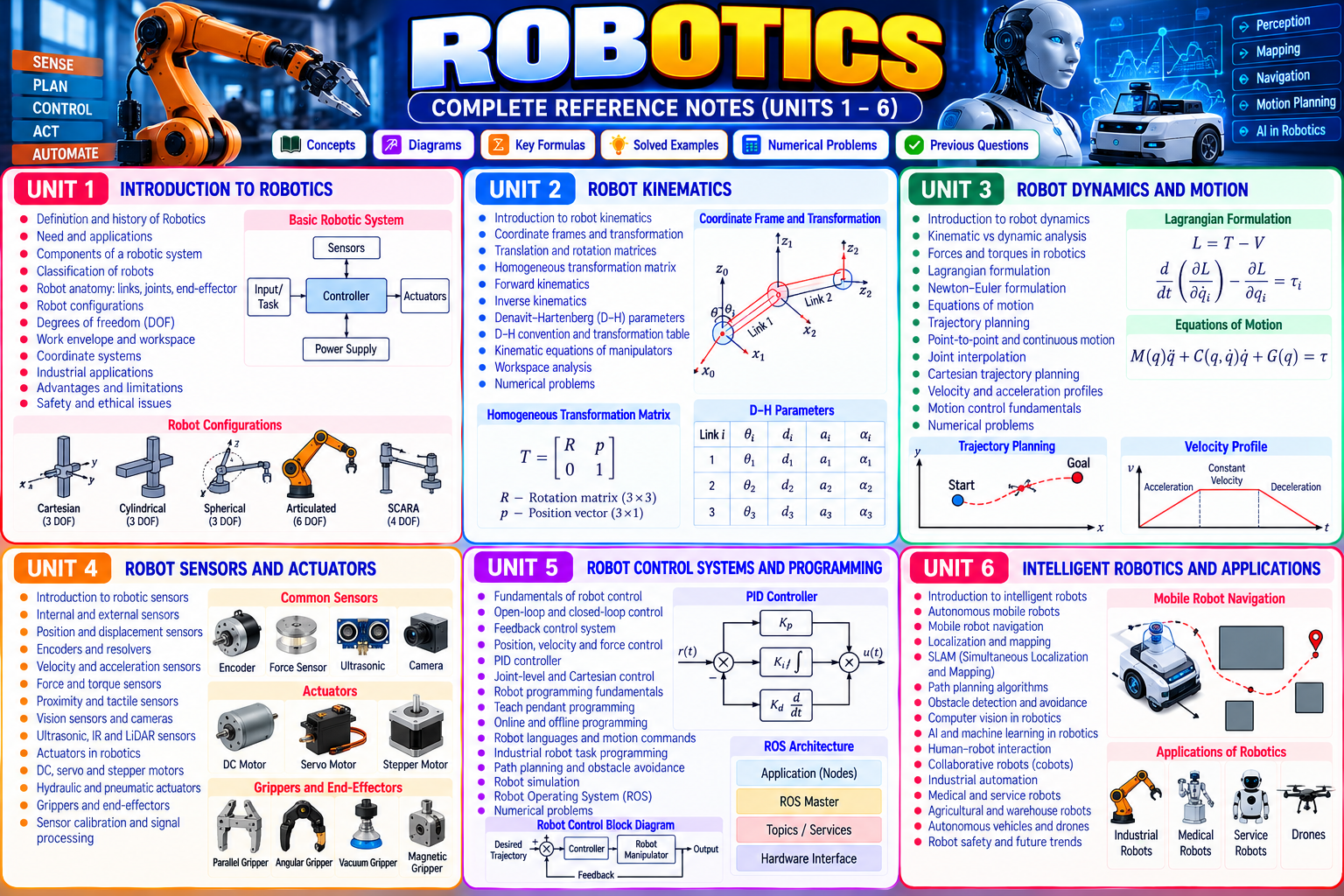
Comprehensive reference material covering the fundamentals of robotics, robot configurations, kinematics, dynamics, sensors, actuators, robot control systems, motion planning and industrial applications. Includes theoretical concepts, mathematical equations, robot diagrams, algorithms and numerical problem topics.
Unit 1 – Introduction to Robotics
Definition and history of robotics
Fundamentals of robotics and automation
Components of a robotic system
Robot anatomy and configurations
Cartesian, cylindrical, spherical and articulated robots
SCARA robots and parallel robots
Classification of robots
Degrees of freedom (DOF)
Robot joints and links
Robot workspace and work envelope
Robot coordinate systems
Industrial robot applications
Advantages, limitations and safety considerations
Unit 2 – Robot Kinematics
Introduction to robot kinematics
Position and orientation representation
Coordinate frames and transformations
Translation and rotation matrices
Homogeneous transformation matrices
Forward kinematics
Inverse kinematics
Robot manipulator geometry
Denavit–Hartenberg (D–H) parameters
D–H convention and transformation tables
Kinematic equations of robotic manipulators
Workspace analysis
Numerical problems on robot kinematics
Unit 3 – Robot Dynamics and Motion
Introduction to robot dynamics
Kinematic versus dynamic analysis
Forces and torques in robotic systems
Joint space and Cartesian space
Lagrangian formulation
Newton–Euler formulation
Equations of motion
Robot trajectory planning
Point-to-point motion
Continuous-path motion
Joint interpolation
Cartesian trajectory planning
Velocity and acceleration profiles
Motion control fundamentals
Unit 4 – Robot Sensors and Actuators
Introduction to robotic sensors
Internal and external sensors
Position and displacement sensors
Encoders and resolvers
Velocity and acceleration sensors
Force and torque sensors
Proximity and tactile sensors
Vision sensors and cameras
Ultrasonic, infrared and LiDAR sensors
Actuators in robotics
Electric motors: DC, servo and stepper motors
Hydraulic and pneumatic actuators
Grippers and end-effectors
Sensor calibration and signal processing
Unit 5 – Robot Control Systems and Programming
Fundamentals of robot control
Open-loop and closed-loop control
Feedback control systems
Position, velocity and force control
PID controllers
Joint-level and Cartesian control
Robot programming fundamentals
Teach pendant programming
Online and offline programming
Robot languages and motion commands
Industrial robot task programming
Path planning and obstacle avoidance
Introduction to robot simulation
Robot Operating System (ROS) fundamentals
Unit 6 – Intelligent Robotics and Applications
Introduction to intelligent robots
Autonomous mobile robots
Mobile robot navigation
Localization and mapping
Simultaneous Localization and Mapping (SLAM)
Path planning algorithms
Obstacle detection and avoidance
Computer vision in robotics
Artificial intelligence and machine learning in robotics
Human–robot interaction
Collaborative robots (cobots)
Industrial automation and manufacturing
Medical and service robots
Agricultural and warehouse robotics
Autonomous vehicles and drones
Robot safety, ethics and future developments
Learning Outcomes
Understand robot configurations, components and degrees of freedom.
Calculate forward and inverse kinematics.
Explain robot dynamics and trajectory planning.
Identify suitable sensors, actuators and end-effectors.
Understand robot control and programming techniques.
Describe intelligent robotics, autonomous navigation and industrial applications.
This reference material is useful for conceptual learning, assignments, laboratory preparation, project development, numerical practice and semester examination revision.
Note: This is a general six-unit reference outline. Actual topics and unit divisions may vary according to your university syllabus.
Preview
3 files — tap a file to preview it