Home›Materials›Foundations of Artificial Intelligence›Foundations of Artificial Intelligence – Complete Study Notes (Units 1–6)
About this material
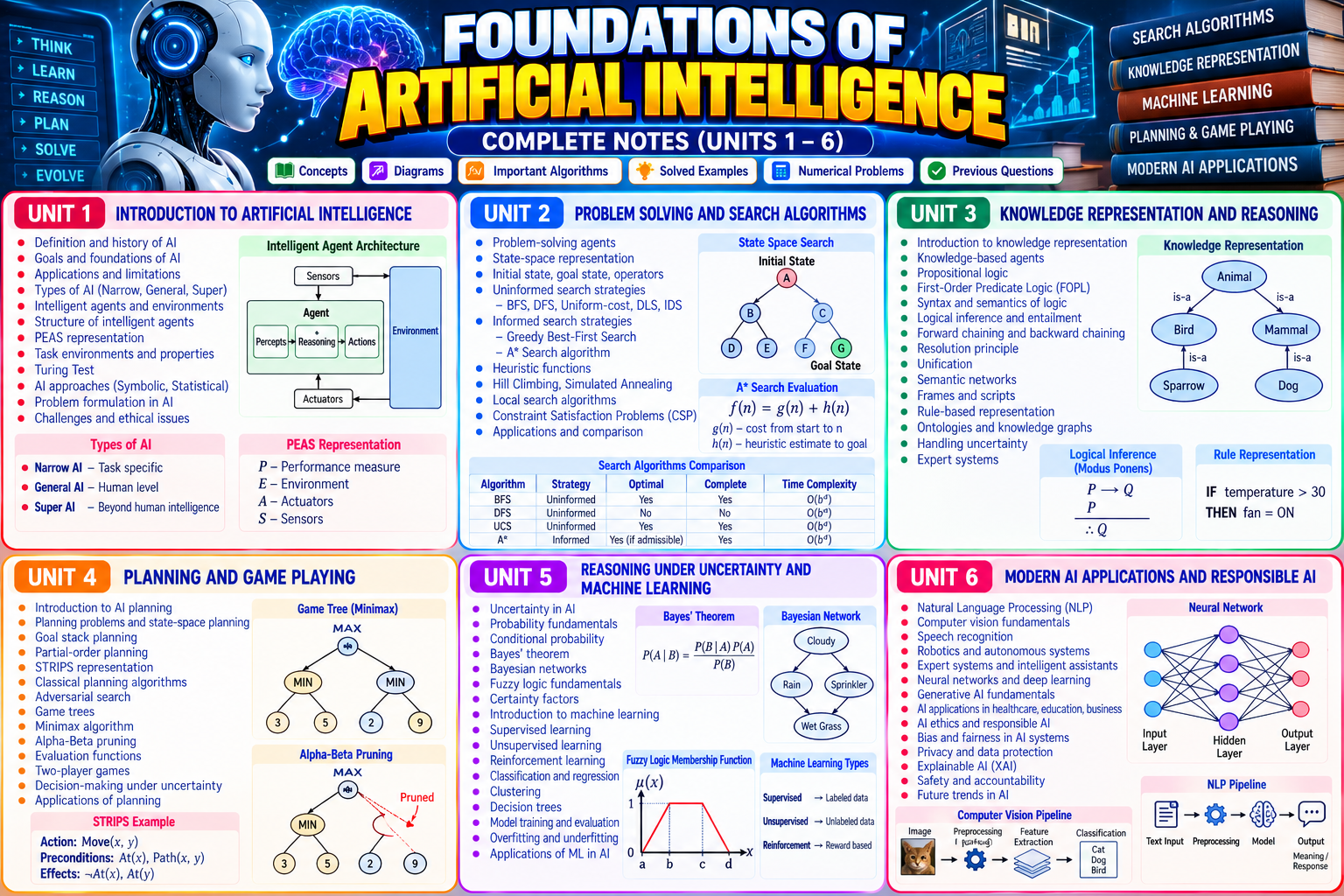
Foundations of Artificial Intelligence – Complete Study Material (Units 1–6)
Comprehensive study material covering AI fundamentals, intelligent agents, problem-solving techniques, search algorithms, knowledge representation, reasoning, machine learning fundamentals and AI applications. Includes important concepts, algorithms, examples, diagrams and exam preparation topics.
Unit 1 – Introduction to Artificial Intelligence
Definition and history of Artificial Intelligence
Goals and foundations of AI
Applications and limitations of AI
Types of AI: Narrow AI, General AI and Super AI
Intelligent systems and rationality
Intelligent agents and environments
Structure and types of intelligent agents
PEAS representation
Task environments and their properties
Turing Test and AI approaches
AI problem formulation
Challenges and ethical considerations in AI
Unit 2 – Problem Solving and Search Algorithms
Problem-solving agents
State-space representation
Initial state, goal state and operators
Uninformed search strategies
Breadth-First Search (BFS)
Depth-First Search (DFS)
Uniform-Cost Search
Depth-Limited Search
Iterative Deepening Search
Bidirectional Search
Informed search strategies
Heuristic functions
Greedy Best-First Search
A* Search algorithm
Admissible and consistent heuristics
Hill Climbing
Simulated Annealing
Local search algorithms
Constraint Satisfaction Problems (CSP)
Applications and comparison of search algorithms
Unit 3 – Knowledge Representation and Reasoning
Introduction to knowledge representation
Knowledge-based agents
Propositional logic
First-Order Predicate Logic
Syntax and semantics of logic
Logical inference and entailment
Forward chaining and backward chaining
Resolution principle
Unification
Semantic networks
Frames and scripts
Rule-based representation
Ontologies and knowledge graphs
Handling uncertainty in knowledge
Introduction to expert systems
Unit 4 – Planning and Game Playing
Introduction to AI planning
Planning problems and state-space planning
Goal stack planning
Partial-order planning
STRIPS representation
Classical planning algorithms
Adversarial search
Game trees
Minimax algorithm
Alpha-Beta pruning
Evaluation functions
Two-player games
Decision-making under uncertainty
Applications of planning in AI
Unit 5 – Reasoning Under Uncertainty and Machine Learning
Uncertainty in Artificial Intelligence
Probability fundamentals for AI
Conditional probability and Bayes' theorem
Bayesian networks
Fuzzy logic fundamentals
Certainty factors
Introduction to machine learning
Supervised learning
Unsupervised learning
Reinforcement learning fundamentals
Classification and regression
Clustering
Decision trees
Model training and evaluation
Overfitting and underfitting
Applications of machine learning in AI
Unit 6 – Modern AI Applications and Responsible AI
Natural Language Processing (NLP)
Computer vision fundamentals
Speech recognition
Robotics and autonomous systems
Expert systems and intelligent assistants
Introduction to neural networks and deep learning
Generative AI fundamentals
AI applications in healthcare, education and business
AI ethics and responsible AI
Bias and fairness in AI systems
Privacy and data protection
Explainable AI
Safety, accountability and limitations of AI
Future trends in Artificial Intelligence
Learning Outcomes
Understand the foundations and principles of Artificial Intelligence.
Identify intelligent agents and formulate AI problems.
Apply search algorithms to problem-solving tasks.
Understand knowledge representation and logical reasoning.
Explain planning, game-playing and decision-making techniques.
Understand machine learning fundamentals and modern AI applications.
Recognize ethical, privacy and safety challenges in AI.
This study material is useful for class preparation, assignments, algorithm practice, revision and semester examination preparation.
Note: This is a general six-unit reference outline. Exact topics and unit divisions may vary according to your university syllabus.
Preview
5 files — tap a file to preview it