Home›Materials›Communication Systems›Communication Systems – Complete Study Notes (Units 1–6)
About this material
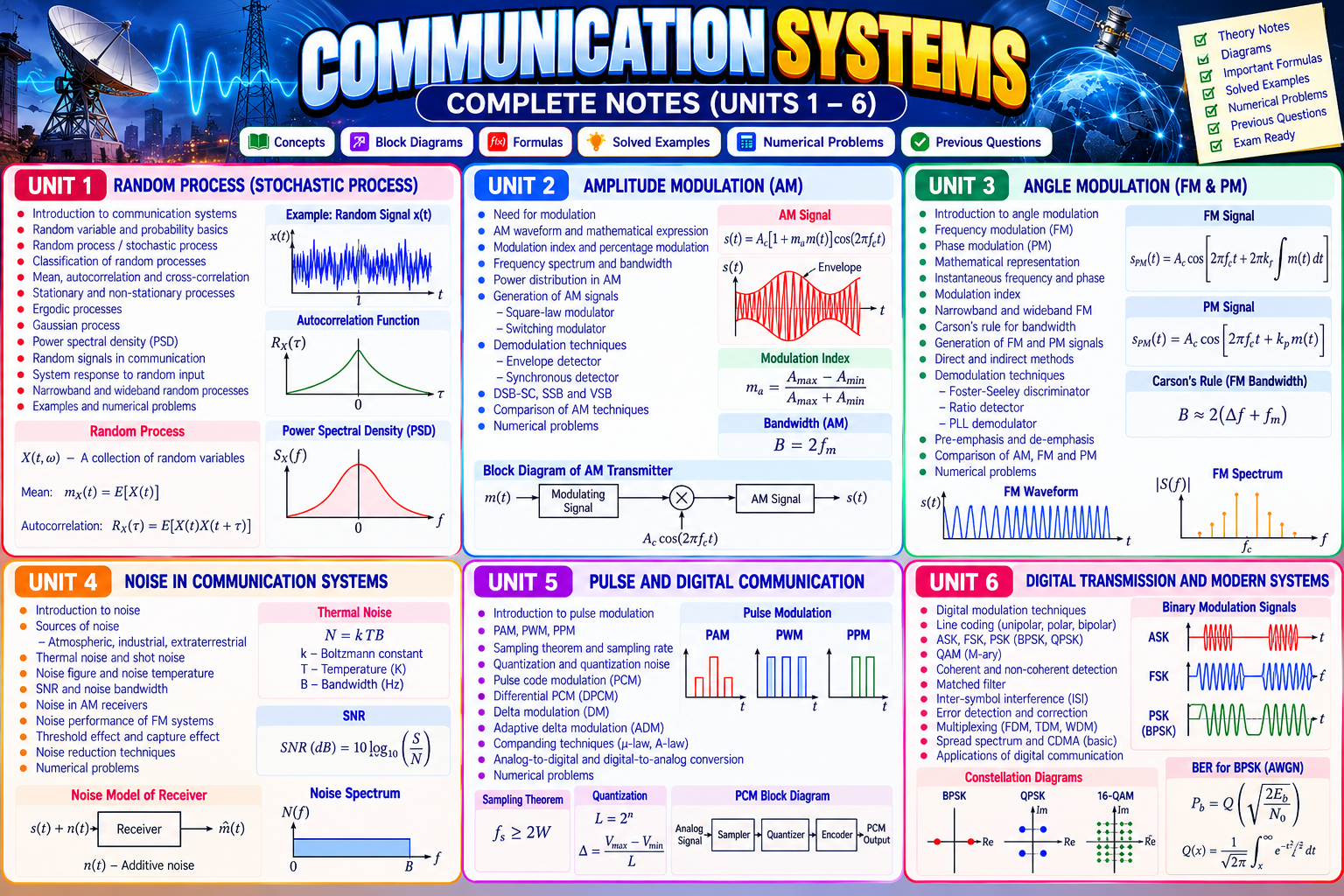
Communication Systems – Complete Study Material (Units 1–6)
Comprehensive study material covering analog communication, amplitude modulation, frequency modulation, noise analysis, digital communication, pulse modulation and digital transmission techniques. Includes important concepts, mathematical formulas, block diagrams, waveforms and numerical problem topics.
Unit 1 – Introduction to Communication Systems
Fundamentals of communication systems
Basic communication system block diagram
Information sources and communication channels
Transmitters, receivers and communication media
Baseband and passband signals
Electromagnetic spectrum and frequency bands
Need for modulation
Types of modulation
Amplitude, frequency and phase modulation
Time-domain and frequency-domain representations
Bandwidth and power considerations
Communication system performance parameters
Unit 2 – Amplitude Modulation (AM)
Amplitude modulation fundamentals
AM waveform and mathematical representation
Modulation index and percentage modulation
AM frequency spectrum and bandwidth
Power distribution in AM signals
Sidebands and carrier power
Generation of AM signals
Square-law and switching modulators
AM demodulation techniques
Envelope detector
Double Sideband Suppressed Carrier (DSB-SC)
Single Sideband (SSB) modulation
Vestigial Sideband (VSB) modulation
Numerical problems on AM
Unit 3 – Angle Modulation: FM and PM
Fundamentals of angle modulation
Frequency modulation (FM)
Phase modulation (PM)
Mathematical representation of FM signals
Frequency deviation and modulation index
Narrowband and wideband FM
FM bandwidth using Carson's rule
FM generation methods
Direct and indirect FM generation
FM demodulation techniques
Foster-Seeley discriminator
Ratio detector and PLL-based demodulation
Comparison of AM, FM and PM
Pre-emphasis and de-emphasis
Numerical problems on angle modulation
Unit 4 – Noise in Communication Systems
Introduction to noise
External and internal noise
Atmospheric, industrial and extraterrestrial noise
Thermal noise and shot noise
Noise figure and noise temperature
Signal-to-noise ratio (SNR)
Noise in AM receivers
Noise performance of FM systems
Noise bandwidth
Figure of merit
Threshold effect in FM
Capture effect
Noise reduction techniques
Numerical problems on noise analysis
Unit 5 – Pulse and Digital Communication
Introduction to pulse modulation
Pulse Amplitude Modulation (PAM)
Pulse Width Modulation (PWM)
Pulse Position Modulation (PPM)
Sampling theorem
Nyquist sampling rate
Quantization and quantization noise
Pulse Code Modulation (PCM)
Differential PCM (DPCM)
Delta Modulation (DM)
Adaptive Delta Modulation (ADM)
Companding techniques
Analog-to-digital and digital-to-analog conversion
Numerical problems on pulse modulation
Unit 6 – Digital Transmission and Modern Communication
Fundamentals of digital communication
Line coding techniques
Unipolar, polar and bipolar coding
On-Off Keying (OOK)
Amplitude Shift Keying (ASK)
Frequency Shift Keying (FSK)
Phase Shift Keying (PSK)
Binary PSK (BPSK) and Quadrature PSK (QPSK)
Quadrature Amplitude Modulation (QAM)
Coherent and non-coherent detection
Matched filters
Inter-symbol interference (ISI)
Basics of error detection and correction
Introduction to multiplexing: FDM, TDM and WDM
Applications of digital communication systems
Learning Outcomes
Understand the fundamentals of analog and digital communication.
Analyze AM, FM and PM signals.
Calculate modulation index, bandwidth, power and SNR.
Understand noise sources and their effects on communication.
Explain sampling, quantization, PCM and delta modulation.
Understand digital modulation techniques and transmission systems.
This study material is useful for class preparation, assignments, numerical practice, revision and semester examination preparation.
Note: This is a general six-unit reference outline. Exact topics and unit divisions may vary according to your university syllabus.
Preview
8 files — tap a file to preview it
Files
Preview of Communication Systems – Complete Study Notes (Units 1–6)
Downloads
- Download
1 Random Process.pdf
PDF · 30.2 MB
- Download
2 Spectral Properties of Random Process.pdf
PDF · 18.8 MB
- Download
CMS-1 unit3&4.pdf
PDF · 32.8 MB
- Download
Communication Theory.pdf
PDF · 1.8 MB
- Download
CS-1 chapter 2.pdf
PDF · 9.6 MB
- Download
CS-1 unit-1.pdf
PDF · 13.2 MB
- Download
FM-1.pdf
PDF · 6.4 MB
- Download
FM-2.pdf
PDF · 2.8 MB