Home›Materials›Digital Signal Processing (DSP)›Digital Signal Processing (DSP) – Complete Study Notes (Units 1–6)
About this material
Digital Signal Processing (DSP) – Complete Study Material (Units 1–6)
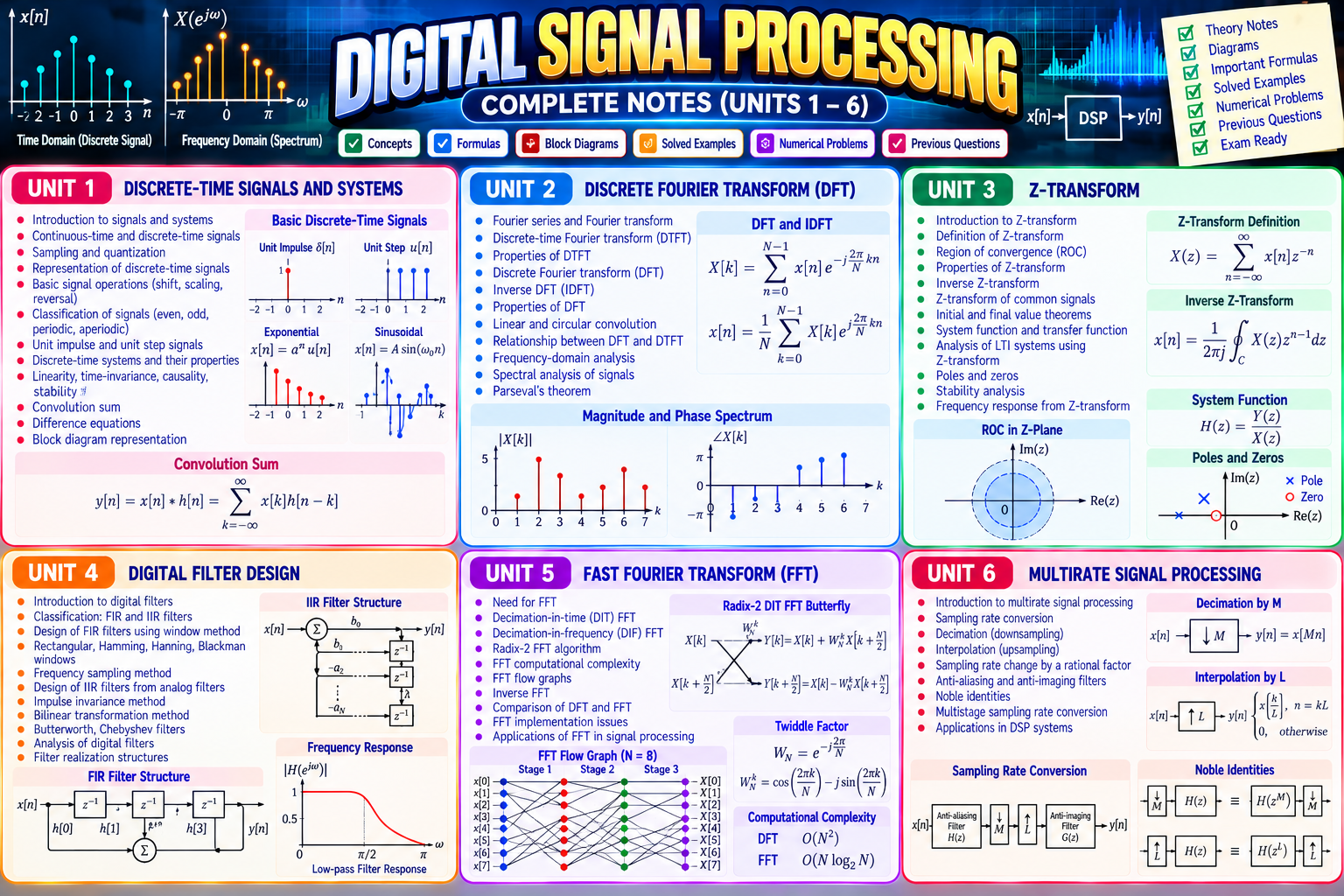
Comprehensive study material covering discrete-time signals and systems, discrete Fourier transforms, Z-transforms, digital filter design, Fast Fourier Transform (FFT) and multirate signal processing. Includes important concepts, mathematical formulas, block diagrams, frequency-response plots and numerical problem topics.
Unit 1 – Discrete-Time Signals and Systems
Introduction to Digital Signal Processing
Continuous-time and discrete-time signals
Signal sampling and quantization
Classification of signals: periodic, aperiodic, even, odd, energy and power signals
Basic discrete-time signals: impulse, unit step, ramp and exponential
Signal operations: shifting, scaling, folding and addition
Classification of systems
Linearity and time invariance
Causality and stability
Discrete-time LTI systems
Impulse response and convolution sum
Difference equations
Block diagram representation of discrete-time systems
Sampling theorem and aliasing fundamentals
Unit 2 – Discrete Fourier Transform (DFT)
Introduction to Fourier analysis
Discrete-Time Fourier Transform (DTFT)
Properties of DTFT
Discrete Fourier Transform (DFT)
Inverse Discrete Fourier Transform (IDFT)
DFT properties: periodicity, symmetry and linearity
Circular shift and circular convolution
Linear convolution using DFT
Relationship between DFT and DTFT
Frequency-domain analysis
Magnitude and phase spectra
Parseval's theorem
Numerical problems on DFT and IDFT
Unit 3 – Z-Transform
Introduction to the Z-transform
Definition and mathematical representation
Bilateral and unilateral Z-transforms
Region of Convergence (ROC)
Properties of the Z-transform
Z-transforms of standard sequences
Inverse Z-transform
Partial fraction expansion
Long division method
Power series expansion
Initial and final value theorems
System function and transfer function
Poles and zeros
Stability and causality using ROC
Analysis of discrete-time LTI systems using Z-transforms
Unit 4 – Digital Filter Design
Introduction to digital filters
FIR and IIR filter classification
Ideal filter characteristics
Low-pass, high-pass, band-pass and band-stop filters
Frequency response of digital filters
FIR filter design using window methods
Rectangular, Hamming, Hanning and Blackman windows
Frequency sampling method
IIR filter design from analog filters
Impulse invariance method
Bilinear transformation method
Butterworth filter design
Chebyshev filter design
Filter realization structures
Direct Form I and Direct Form II
Cascade and parallel structures
Unit 5 – Fast Fourier Transform (FFT)
Introduction to FFT
Need for fast computation of DFT
Computational complexity of DFT and FFT
Decimation-in-Time (DIT) FFT
Decimation-in-Frequency (DIF) FFT
Radix-2 FFT algorithm
Butterfly computation
Bit-reversal ordering
Twiddle factors and their properties
FFT flow graphs
Inverse FFT
Comparison of DFT and FFT
Numerical problems on FFT
Applications of FFT in spectrum analysis and digital communications
Unit 6 – Multirate Signal Processing
Introduction to multirate signal processing
Sampling-rate conversion
Downsampling and decimation
Upsampling and interpolation
Decimation by an integer factor
Interpolation by an integer factor
Anti-aliasing and anti-imaging filters
Rational sampling-rate conversion
Polyphase decomposition
Noble identities
Multistage sampling-rate conversion
Filter-bank fundamentals
Applications of multirate DSP
Audio, speech, image and communication signal processing applications
Learning Outcomes
Understand discrete-time signals and systems.
Analyze LTI systems using convolution and difference equations.
Calculate DFT, IDFT and Z-transforms.
Design and analyze FIR and IIR digital filters.
Implement FFT algorithms efficiently.
Understand sampling-rate conversion and multirate processing.
This material is useful for class preparation, assignments, numerical practice, revision and semester examination preparation.
Note: This is a general six-unit reference outline. Unit divisions and topics may differ according to your university syllabus.
Preview
16 files — tap a file to preview it
Files
Preview of Digital Signal Processing (DSP) – Complete Study Notes (Units 1–6)
Downloads
- Download
DSP UNIT 1.pdf
PDF
- Download
unit 1.pdf
PDF
- Download
unit 2.pdf
PDF
- Download
Unit2 _ DSP.pdf
PDF
- Download
UNIT-5.pdf
PDF
- Download
DSP_UNIT_5.pdf
PDF
- Download
DSP UNIT 3,4.pdf
PDF
- Download
unit4.pdf
PDF
- Download
Unit 6.1.pdf
PDF
- Download
Unit 6.2.pdf
PDF
- Download
DSP 4.pdf
PDF
- Download
DSP UNIT 2.pdf
PDF
- Download
DSP UNIT 4.pdf
PDF
- Download
DSP unit 5.pdf
PDF
- Download
DSP UNIT 6.pdf
PDF
- Download
DSP Unit1.pdf
PDF