Home›Materials›Control Systems›Control Systems – Complete Study Notes (Units 1–6)
About this material
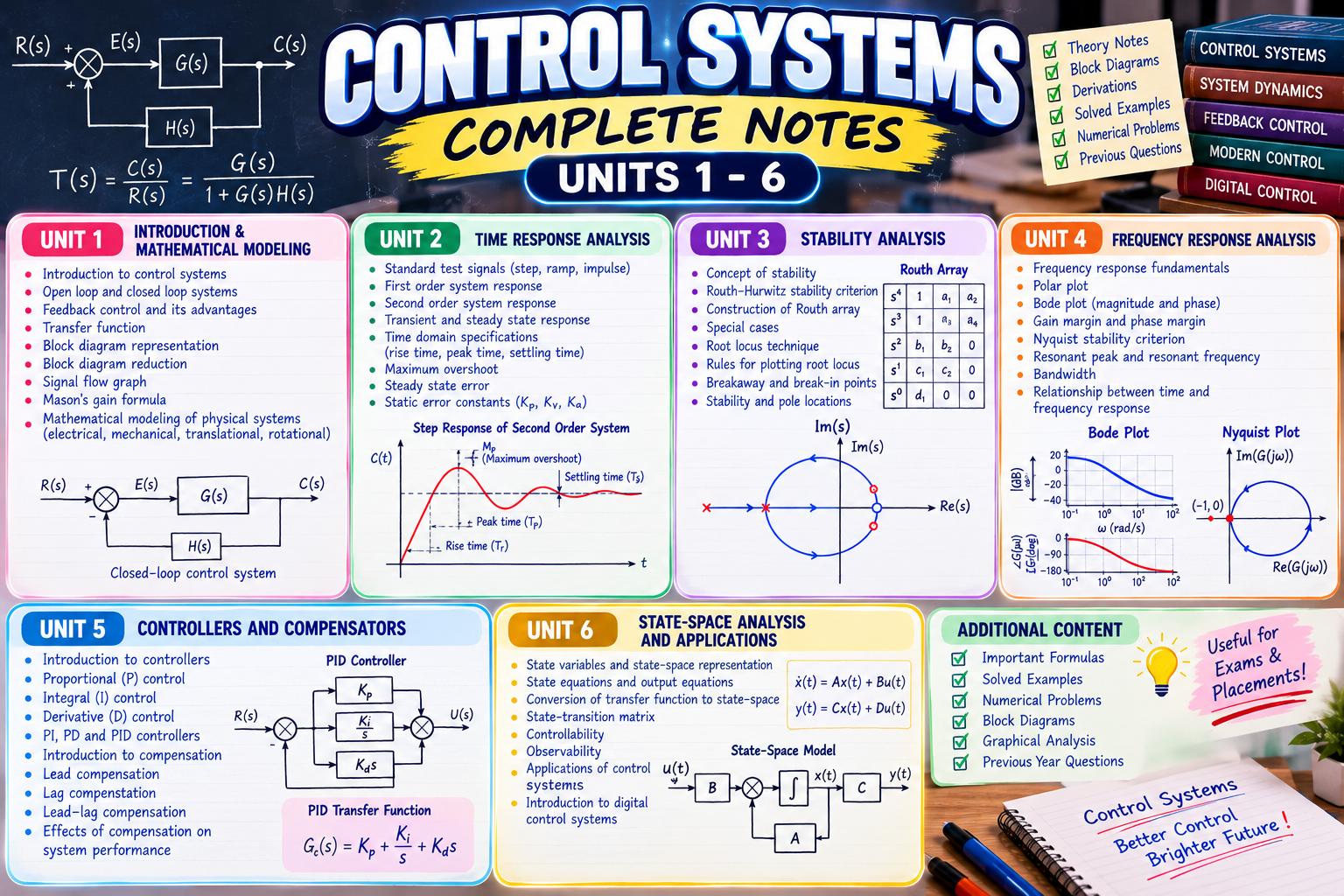
Comprehensive study material covering the fundamental concepts of Control Systems, including mathematical modeling, transfer functions, block diagrams, signal flow graphs, time response, stability analysis, frequency response and control system design.
Unit 1 – Introduction to Control Systems and Mathematical Modeling
Introduction to control systems
Open-loop and closed-loop control systems
Feedback principles and applications
Mathematical modeling of physical systems
Transfer functions
Block diagram representation and reduction
Signal flow graphs
Mason’s gain formula
Electrical and mechanical system modeling
Unit 2 – Time Response Analysis
Standard test signals
Time response of first-order systems
Second-order system response
Transient and steady-state response
Time-domain specifications
Rise time, peak time and settling time
Maximum overshoot
Steady-state error
Static error constants
Effects of system parameters on response
Unit 3 – Stability Analysis
Concept of stability
Absolute, relative and marginal stability
Routh-Hurwitz stability criterion
Construction of Routh arrays
Special cases in Routh stability analysis
Root locus technique
Rules for plotting root locus
Breakaway and break-in points
Stability and pole locations
Unit 4 – Frequency Response Analysis
Frequency response fundamentals
Polar plots
Bode plots
Gain margin and phase margin
Nyquist stability criterion
Resonant peak and resonant frequency
Bandwidth and frequency-domain specifications
Correlation between time and frequency responses
Unit 5 – Controllers and Compensators
Introduction to controllers
Proportional (P) control
Integral (I) control
Derivative (D) control
PI, PD and PID controllers
Introduction to compensation
Lead compensation
Lag compensation
Lead-lag compensation
Effects of compensation on system performance
Unit 6 – State-Space Analysis and Control System Applications
State variables and state-space representation
State equations and output equations
Conversion of transfer functions to state-space models
State-transition matrix
Controllability
Observability
Applications of control systems
Introduction to digital control systems
Learning Outcomes
Understand open-loop and closed-loop control systems.
Develop mathematical models and transfer functions.
Analyze transient response and steady-state errors.
Evaluate system stability using Routh, root locus and frequency-response methods.
Understand controllers, compensators and state-space analysis.
This material is useful for class preparation, assignments, numerical problem practice, revision and semester examination preparation.
Note: Unit-wise topics may vary by university syllabus. Please verify against your prescribed syllabus before publishing.
Preview
12 files — tap a file to preview it
Files
Preview of Control Systems – Complete Study Notes (Units 1–6)
Downloads
- Download
CS-UNIT-6.pdf
PDF · 16.8 MB
- Download
Frequency Response Analysis.pdf
PDF · 15.0 MB
- Download
UNIT-5.pdf
PDF · 56.2 MB
- Download
cs unit 1_compressed.pdf
PDF · 3.7 MB
- Download
CS UNIT 4_compressed.pdf
PDF · 5.2 MB
- Download
CS_Unit-5&6.pdf
PDF · 7.2 MB
- Download
Polar Plot.pdf
PDF · 1.2 MB
- Download
UNIT-4.pdf
PDF · 7.4 MB
- Download
UNIT-6.pdf
PDF · 8.0 MB
- Download
UNIT1&2.pdf
PDF · 19.4 MB
- Download
UNIT3&4.pdf
PDF · 13.4 MB
- Download
UNIT5&6.pdf
PDF · 7.2 MB