Home›Materials›Analog Electronic Circuits›Analog Electronic Circuits – Complete Study Notes (Units 1–6)
About this material
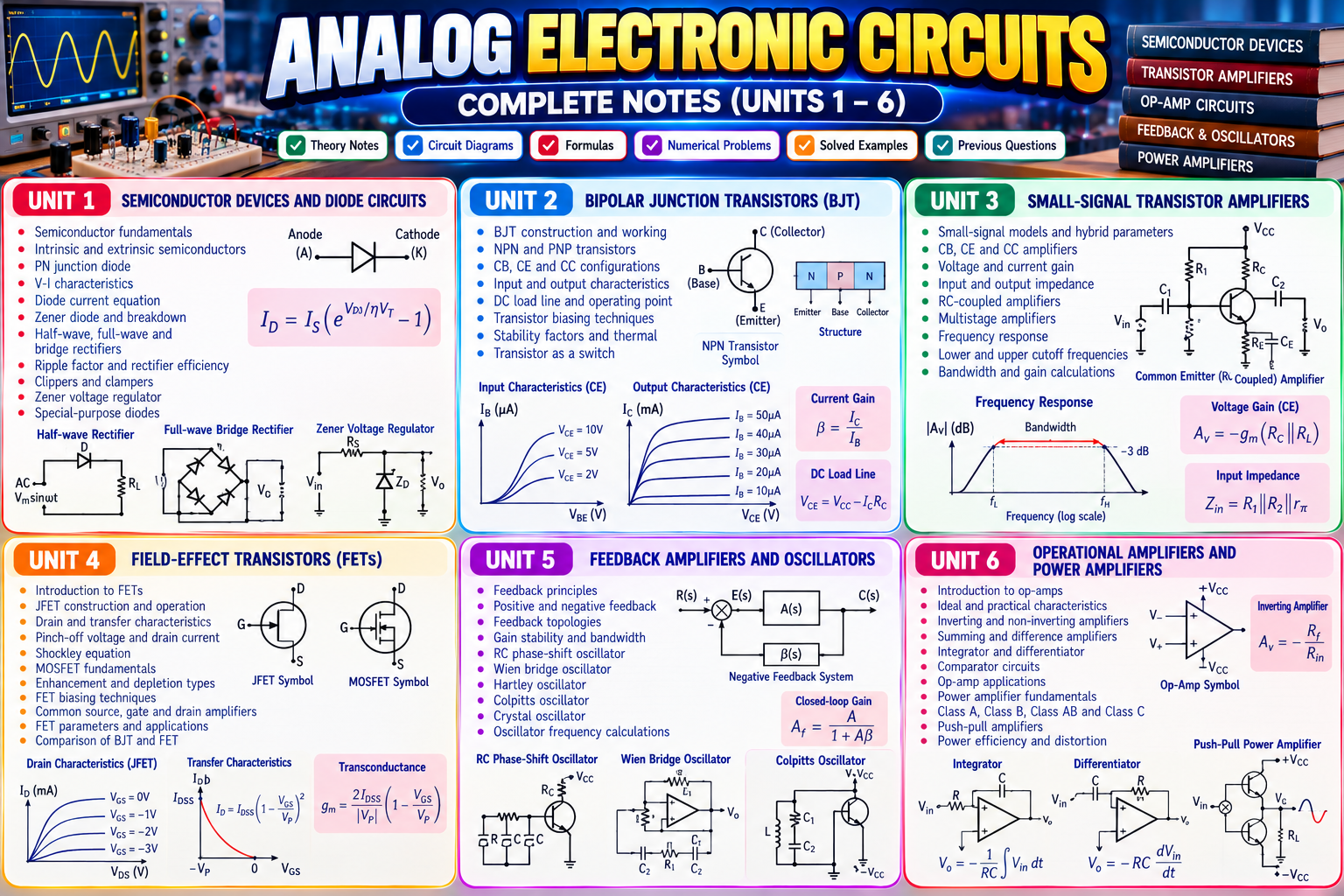
Analog Electronic Circuits (AEC) – Complete Study Material (Units 1–6)
Comprehensive study material covering semiconductor devices, diode applications, transistor biasing, small-signal amplifiers, feedback amplifiers, oscillators and operational amplifier circuits. Includes fundamental concepts, circuit diagrams, important formulas and numerical problem topics.
Unit 1 – Semiconductor Devices and Diode Circuits
Semiconductor fundamentals
Intrinsic and extrinsic semiconductors
PN junction diode construction and operation
Diode V-I characteristics
Diode current equation
Zener diode and breakdown mechanisms
Rectifiers: half-wave, full-wave and bridge
Rectifier efficiency, ripple factor and PIV
Clippers and clampers
Zener voltage regulators
Special-purpose diodes and applications
Unit 2 – Bipolar Junction Transistors (BJT)
BJT construction and working principle
NPN and PNP transistors
Common Base, Common Emitter and Common Collector configurations
Input and output characteristics
Transistor current equations
Current gains: alpha and beta
DC load line and operating point
Transistor as a switch
Transistor biasing techniques
Fixed bias and collector-to-base bias
Voltage-divider bias
Stability factors and thermal runaway
Unit 3 – Small-Signal Transistor Amplifiers
Introduction to amplifiers
Classification of amplifiers
Small-signal transistor models
Hybrid parameters and equivalent circuits
Common Emitter amplifier
Common Base amplifier
Common Collector amplifier
Voltage gain and current gain
Input and output impedance
RC-coupled amplifiers
Multistage amplifiers
Frequency response
Lower and upper cutoff frequencies
Bandwidth and gain calculations
Unit 4 – Field-Effect Transistors (FETs)
Introduction to FETs
JFET construction and operation
Drain and transfer characteristics
Pinch-off voltage and drain current
Shockley equation
MOSFET fundamentals
Depletion and enhancement MOSFETs
FET parameters and transconductance
FET biasing techniques
Common Source amplifier
Common Gate amplifier
Common Drain amplifier
Comparison of BJT and FET
Applications of FETs and MOSFETs
Unit 5 – Feedback Amplifiers and Oscillators
Feedback principles
Positive and negative feedback
Advantages and disadvantages of feedback
Feedback topologies
Voltage-series, voltage-shunt, current-series and current-shunt feedback
Gain stability and bandwidth
Oscillator fundamentals
Barkhausen criterion
RC phase-shift oscillator
Wien bridge oscillator
Hartley oscillator
Colpitts oscillator
Crystal oscillators
Oscillator frequency calculations
Unit 6 – Operational Amplifiers and Power Amplifiers
Introduction to operational amplifiers
Ideal and practical op-amp characteristics
Differential amplifier
Inverting and non-inverting amplifiers
Voltage follower
Summing amplifier
Difference amplifier
Integrator and differentiator
Comparator circuits
Op-amp applications
Power amplifier fundamentals
Class A, Class B, Class AB and Class C amplifiers
Push-pull amplifiers
Power efficiency and distortion
Electronic circuit applications
Learning Outcomes
Understand semiconductor device operation and characteristics.
Analyze diode circuits and transistor configurations.
Calculate amplifier gain, impedance and frequency response.
Understand feedback principles and oscillator operation.
Design and analyze basic operational amplifier circuits.
Practice circuit diagrams, formulas and numerical problems.
This material is useful for class preparation, assignments, laboratory preparation, revision and semester examination preparation.
Note: The six-unit structure is a general reference outline. Topics and unit divisions may vary according to your university syllabus.
Preview
16 files — tap a file to preview it
Files
Preview of Analog Electronic Circuits – Complete Study Notes (Units 1–6)
Downloads
- Download
AEC-1.pdf
PDF · 30.0 MB
- Download
all-units-reference.pdf
PDF · 79.7 MB
- Download
AEC 1-5 chapters.pdf
PDF · 55.3 MB
- Download
unit-1.pdf
PDF · 23.4 MB
- Download
unit-2.pdf
PDF · 18.6 MB
- Download
unit-3.pdf
PDF · 13.8 MB
- Download
unit-4.pdf
PDF · 21.4 MB
- Download
AEC_Unit 5 _ BJT Small signal analysis.pdf
PDF · 39.3 MB
- Download
AEC unit6.pdf
PDF · 3.8 MB
- Download
AEC-UNIT-1(BJT).pdf
PDF · 22.6 MB
- Download
BJT Current Mirrors Prblms.pdf
PDF · 8.4 MB
- Download
BJT-Diff-Amp-3 (1).pdf
PDF · 167 KB
- Download
current mirror.pdf
PDF · 2.7 MB
- Download
UNIT 1 AEC.pdf
PDF · 8.9 MB
- Download
unit-2 AEC MOSFET.pdf
PDF · 8.1 MB
- Download
unit-3 AEC MOSFET.pdf
PDF · 2.5 MB